




Transforming medicine and changing lives
December 9, 2025
AskBio’s AB-1005 and AB-1002 Receive Pioneering Regenerative Medical Product Designation in JapanNot intended for UK Media Berlin, Germany, and Durham, N.C., USA, December 9, 2025 – AskBio Inc., a gene therapy company wholly owned and independently operated as a subsidiary of Bayer AG, today announced that Japan’s Ministry of Health, Labour and Welfare (MHLW) has granted the Pioneering Regenerative Medical Product designation (SAKIGAKE) for two of AskBio’s investigational gene therapy programs: AB-1005, for the treatment of Parkinson’s disease (PD), and AB-1002, for the treatment of non-ischemic heart failure with reduced left ventricular ejection fraction and New York Heart Association (NYHA) Class III heart failure despite appropriate medical therapy. The designation reflects Japan’s commitment to expediting the development and review of breakthrough therapies and is awarded to products demonstrating innovativeness (a new mode of action), prominent efficacy or safety data, and the potential to address severe diseases, especially when submitted first or simultaneously with other countries. This recognition offers significant advantages, including priority consultations and accelerated review timelines, thereby facilitating earlier participant access to transformative treatments. “Having AB-1005 and AB-1002 receive the Pioneering Regenerative Medical Product designation in Japan highlights our dedication to advancing innovative gene therapies for participants facing serious diseases,” said Canwen Jiang, MD, PhD, Chief Development Officer and Chief Medical Officer, AskBio. “This recognition not only accelerates regulatory review but also reaffirms our commitment to delivering advanced treatments to those living with serious chronic diseases that lack therapies targeting root causes.” AB-1005, currently being evaluated in the Phase II REGENERATE-PD trial, is an investigational gene therapy with adeno-associated viral (AAV) vector-mediated delivery of the glial cell line-derived neurotrophic factor (GDNF) gene for participants with moderate-stage PD. The therapy aims to restore neuronal function and potentially slow disease progression for people with limited treatment options. AB-1005 previously received US Food and Drug Administration (FDA) Regenerative Medicine Advanced Therapy (RMAT), FDA Fast Track, and UK Medicines and Healthcare products Regulatory Agency (MHRA) Innovation Passport designations, underscoring its global significance and potential for participants.1 AB-1002 is an investigational AAV gene therapy being studied for the treatment of adults with NYHA Class III heart failure with non-ischemic etiology. It previously received FDA Fast Track designation, and is designed as a one-time gene therapy targeting protein phosphatase 1 inhibition, with the intention of improving cardiac function and addressing the substantial global burden of congestive heart failure.2 “Bayer and AskBio’s collaboration continues to drive progress in gene therapy with a robust pipeline targeting central nervous system, cardiovascular, and other disease indications,” said Christian Rommel, PhD and Global Head of Research and Development for Bayer’s Pharmaceuticals Division. “Receiving the designation in Japan, which is a first for Bayer, marks an important milestone in expanding global access to pioneering therapies and reinforces our shared commitment to delivering breakthrough science to improve outcomes for patients worldwide.” FDA RMAT is a designation granted by the FDA to regenerative therapies, including gene therapies, being developed to treat, modify, reverse, or cure serious or life-threatening diseases or conditions.3 Investigational products receiving this designation must have produced preliminary clinical evidence indicating that they ...read the news
We are on a never-ending quest to advance genetic technology
and AAV gene therapy
In 1984, Dr. Jude Samulski, one of AskBio’s visionary founders, asked if a virus could be used to target genetic disease. Researching this question cleared the path for historic advances in genetic medicine, and AskBio is helping to lead the way.
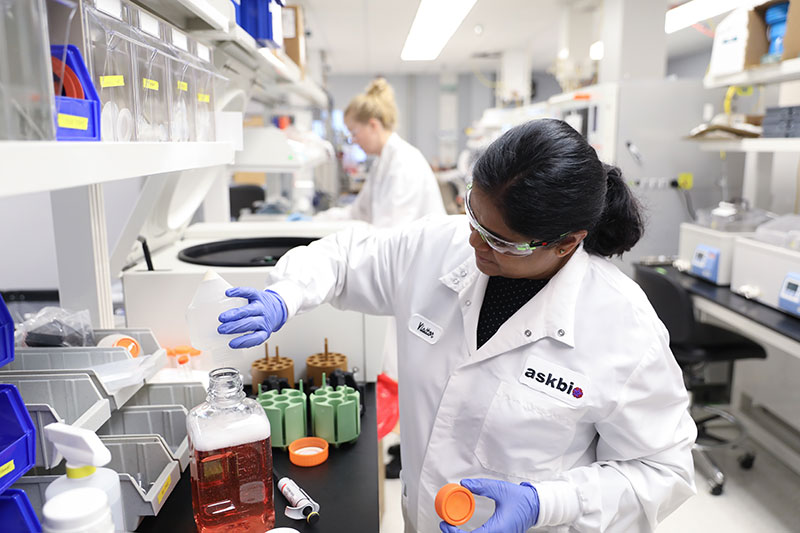
Advancing gene therapy
Treatments for life-altering diseases require new technology to lower the production cost of treatment and increase supply for patients who need it.
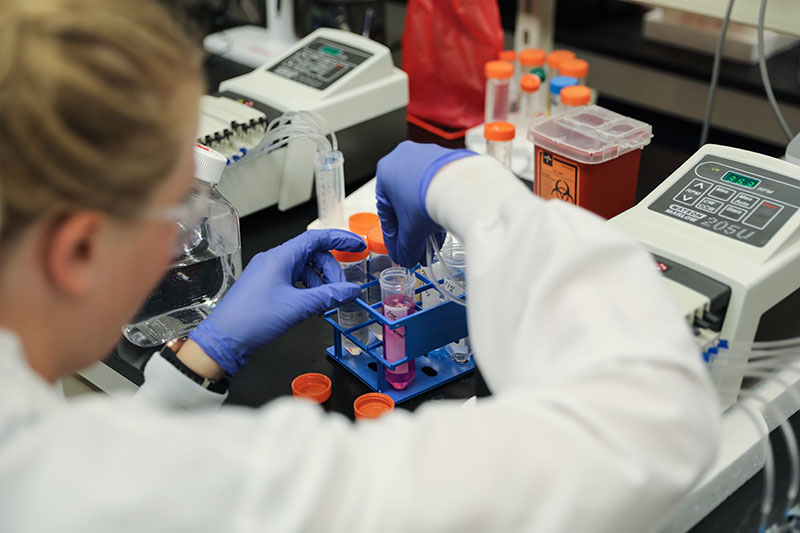
Changing lives
Our clinical pipeline is the direct result of listening to patients, their families, their care teams and disease-advocacy organizations.

Putting patient care first
The voices of patients drive everything we do. They propel our research and the urgent need to find treatments.

Work with us
Advancing research
Today’s genetic discoveries are some of the most awe-inspiring advances in medical history. We welcome collaboration with innovative minds in genetic R&D.
Building careers
Help transform the face of healthcare with potentially life-changing gene therapy. Every life enriched by our scientific advancements is a result of someone like you.